SalesCRM ( A Salesforce Alternative )
About This Product
Overview
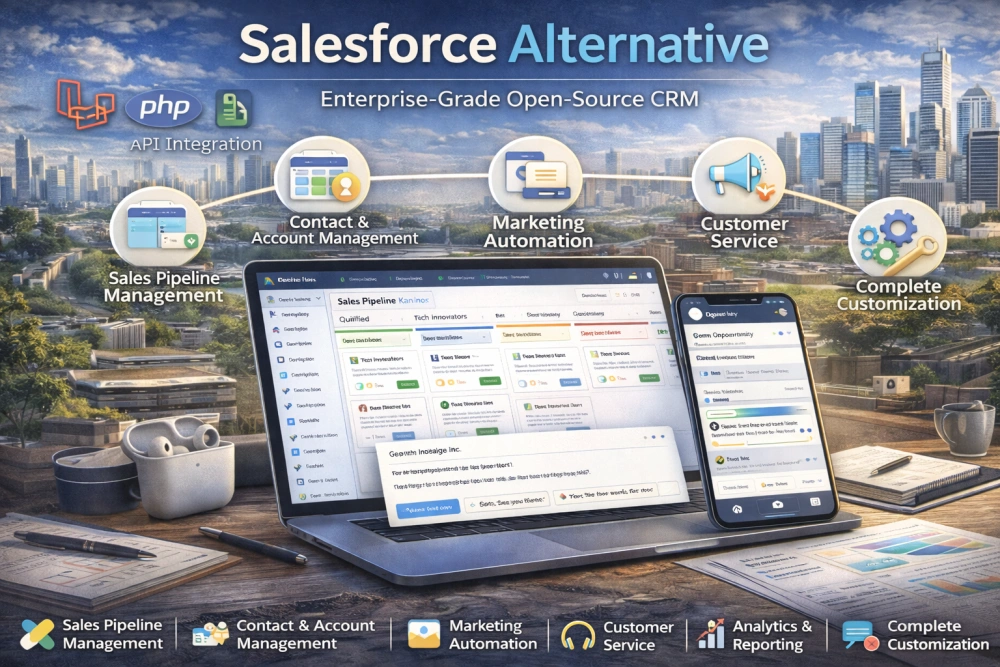
SalesCRM is a comprehensive open-source Customer Relationship Management (CRM) platform, built as a Salesforce alternative, designed to provide businesses with a robust, customizable, and cost-effective solution for managing sales, marketing, and customer service activities. With its open-source foundation, SalesCRM empowers companies to break free from vendor lock-in and subscription fees, ensuring complete data ownership and control. This self-hosted CRM solution is built with Laravel, PHP, MySQL, and modern RESTful APIs, providing a scalable and secure environment for businesses to manage their customer relationships.
For businesses seeking Salesforce alternatives in 2026, SalesCRM offers a compelling option, comparable to other top CRM systems like HubSpot and Zoho. It's an ideal solution for small and medium businesses looking for affordable CRM options without the burden of subscription fees, as well as enterprises requiring data ownership and on-premises deployment. When considering CRM alternatives, it's essential to find options that meet specific business needs, and SalesCRM, with its extensive customization capabilities, stands out as a versatile choice.
Key Features
- Visual Sales Pipeline Management: Utilize kanban boards, drag-and-drop deal tracking, and customizable sales stages to efficiently manage opportunities from lead generation to closed-won deals.
- Comprehensive Contact and Account Management: Enjoy 360-degree customer views, consolidating communication history, deal activity, support tickets, and custom fields for a holistic understanding of customer relationships.
- Marketing Automation: Leverage email campaigns, drip sequences, lead scoring, and segmentation to streamline marketing efforts and enhance campaign ROI.
- Customer Service Module: Manage customer support tickets, SLAs, and knowledge bases, ensuring timely and effective customer service.
- Lead Management: Capture leads with forms, qualify them through workflows, and assign them automatically to the right teams for conversion.
- Opportunity Tracking: Monitor deal values, probabilities, close dates, and forecast reporting for accurate sales pipeline management.
- Customizable Dashboards: Create real-time metrics, KPIs, and visual analytics to track performance and make data-driven decisions.
- Email Integration: Experience two-way sync, template management, and tracking capabilities for seamless communication.
- Calendar Integration: Schedule tasks, appointments, and reminders directly within the CRM for enhanced productivity.
- Document Management: Store contracts, proposals, and customer-related files securely and access them easily.
- API Integration: Connect with third-party tools, including accounting and marketing platforms, for a unified business environment.
- Role-Based Access Control: Manage team hierarchies and permissions to ensure data security and compliance.
- Activity Tracking: Log all customer interactions, including calls, emails, and meetings, for a comprehensive activity history.
- Mobile-Responsive Design: Access the CRM from smartphones and tablets, supporting field sales activities and on-the-go productivity.
- Self-Hosting Support: Deploy SalesCRM on-premises with Docker, ensuring backup automation and multi-tenant capabilities for agencies managing multiple client instances.
Benefits
By choosing SalesCRM, businesses can eliminate ongoing subscription fees, maintain complete data ownership, and customize the platform extensively to match specific business processes and workflows. This results in cost-effective scaling without per-user licensing constraints, free integration with existing systems through open APIs, and enhanced data privacy and security with self-hosted infrastructure. Additionally, SalesCRM helps reduce the total cost of ownership compared to commercial CRM platforms and supports unlimited users without additional licensing costs.
For those wondering what CRM is comparable to Salesforce, SalesCRM stands as a robust alternative, offering similar functionalities without the high costs. It's also worth noting that Salesforce CRM is used for managing sales, marketing, and customer service activities, but it can be difficult to learn for some users due to its complexity. In contrast, SalesCRM provides a more accessible and user-friendly interface, making it easier for teams to adapt and utilize the platform's full potential.
Use Cases
- Small and Medium Businesses: Seeking affordable CRM solutions without subscription fees.
- Enterprises: Requiring data ownership and on-premises CRM deployment for compliance and security reasons.
- Agencies: Managing multiple client CRM instances from a single platform for efficiency and scalability.
- Organizations with Compliance Requirements: Needing to deploy CRM on-premises to meet data residency and compliance standards.
- Businesses Seeking Extensive Customization: Looking for a CRM platform that can be tailored to their specific business processes and workflows.
- Companies Transitioning from Commercial CRM: Seeking to reduce costs and gain more control over their CRM solution.